I've received the final data from the Environment Agency on the 2011 season.
The total declared salmon catch for 2011 stands at 361 of which 331 were reported from the Severn, 10 from the Teme and 20 from the Vyrnwy. This is the second highest catch from the system in the last 15 years.
The 2011 catch is a very significant improvement on 2009 and 2010 seasons which like last year also suffered from low flows in the spring . So what was different? Evidence from a wide range of sources suggest that 2011 was a good year for multi-sea-winter (MSW) salmon throughout the North Atlantic and the Severn clearly benefited from this.
The long term rod catch figures over the last 15 years are relatively stable showing a small upward trend.
However, these catch figures should not be taken at face value as an accurate measure of the long term trend in the salmon population. This is because they do not account for the impact the1999 spring byelaws had in reducing rod effort and the number of salmon caught.
The ban on bait fishing before June 16th effectively closed a substantial part of the Spring Salmon fishery on the Severn, while compulsory catch and release deterred many anglers who were unhappy with treating spring salmon as 'play things'. It is very difficult to quantify the impact of the byelaws, but in 2007 the EA noted that there had been a 58% fall in the median annual pre-June catch on the Severn in comparison to pre-byelaw days, but said that this was 'not significant' as it did not represent any fall in stocks: EA assessment of impact of spring bye laws on salmon catches
Put in layman's terms that means the Severn rod catch has been reduced by around 160 fish per year since 1999 as a result of the spring byelaws. More in good fishing years and less in poor ones.
The real state of stocks is seen more clearly if we look at the underlying trend in catch per unit effort which has improved significantly over the last 15 years.
The catch and release rate has risen to 61% which is above the long term England and Wales average of 56%. This was no doubt helped by awareness raising activities such as the Shakespeare Severn Salmon Competition in which a prize of a Shakespeare Oracle XT fly rod was offered for the largest salmon caught and released from the river.
Nearly two thirds 65% of the fish were caught after June 16th. Spinning was the most productive method (58%) with bait accounting for 34% and the fly 8%.
96 anglers caught Severn, Teme or Vyrnwy salmon last year. Of that just 15 anglers (less than 5% of the total number fishing) caught over 50% of the fish. Sixty anglers (15% of the total) caught 90% of the fish.
The catch breaks down in terms of weight category like this:
Under 8lb: 85
8lb - 14lb: 214
14lb - 22lb: 59
22lb and over: 6
The average and largest weights by river were:
Severn: average 10.55lb largest 30lb
Vyrnwy: average 10.6lb largest 15.6lb
Teme: average 9.48lb largest 13lb
Significantly no large salmon were declared from the Teme last year. This no doubt reflected the very low flows throughout virtually the whole season.
The proportion of large salmon over 14lbs in the rod catch had risen to 18% which represents a significant improvement on the previous 5 year average of 12%.
The monthly capture rate of large salmon is shown below. This could be evidence that large salmon are running later, but we would need the pattern to be repeated over several years and varied flows to establish that. It may well just be a reflection of the very dry April which delayed the arrival of the larger fish at the rod fishery.
Wednesday, 25 April 2012
Monday, 9 April 2012
2011 provisional catch figures
The provisional rod catch for 2011 stands at 332. This figure is based on returns up to mid February. It represents a significant improvement on catches in 2009 and 2010 which like last year suffered from low water. It would be a mistake to try and isolate a single cause for this upturn, but good catches of 2SW fish across much of England and Wales in 2011 suggests that the 2009 smolts may well have found favourable currents after the leaving the rivers. This could keep down marine mortality and boost rod catches.
This catch is another indicator of improving stocks after the collapse in catches in the late '90s.
The 2011 catch was 180% of the 1998 figure. Yet since the late 90's the number of anglers has declined by more than two thirds. This suggests strongly that the stock is increasing. If we look at catch-per-unit-effort we can see the trend over the last decade or so more clearly.
Flows impact very strongly on the distribution of the rod catch with the navigation weirs on the lower river accounting for the majority of fish in low water years. This pattern was again evident in the 2011 catches. The lower river is a very long stretch of river, but the effective fishing area is made up mainly from a handful of weir pools. Over 65% of the fish reported from below Stourport actually came from just one such hotspot: Diglis weir at Worcester.
Prior to 2009 the catch from below Bridgnorth would've been considerably higher in a drought year. However, changes of ownership at one particularly productive low water fishery has led to a big reduction in catches. This is due to less rod effort and highly productive water remaining un-fished.
The graph below represents fish reported to me for the T&S monthly report. It isn't exhaustive, but I believe it does give a broadly accurate picture.
The 2011 catch was 180% of the 1998 figure. Yet since the late 90's the number of anglers has declined by more than two thirds. This suggests strongly that the stock is increasing. If we look at catch-per-unit-effort we can see the trend over the last decade or so more clearly.
Flows impact very strongly on the distribution of the rod catch with the navigation weirs on the lower river accounting for the majority of fish in low water years. This pattern was again evident in the 2011 catches. The lower river is a very long stretch of river, but the effective fishing area is made up mainly from a handful of weir pools. Over 65% of the fish reported from below Stourport actually came from just one such hotspot: Diglis weir at Worcester.
Prior to 2009 the catch from below Bridgnorth would've been considerably higher in a drought year. However, changes of ownership at one particularly productive low water fishery has led to a big reduction in catches. This is due to less rod effort and highly productive water remaining un-fished.
The graph below represents fish reported to me for the T&S monthly report. It isn't exhaustive, but I believe it does give a broadly accurate picture.
Saturday, 24 March 2012
The grumpy faction's myths and prejudices - Number 2: The Putchers
Anglers being anglers exaggeration, gossip and plain untruth spreads as quickly in our ranks as do tales of fish caught or lost. The result is that most angling communities have a set of urban myths that are repeated so often that people believe them to be true. Severn salmon anglers are no different. Many of these myths come from the 'doom and gloomers', what I would call the grumpy faction, people who only seem to be happy when they've got something to moan about.
This is the second of a series of articles designed to debunk some of these myths by looking at the facts and coming up with a more balanced view.
‘With the putchers off we should be catching hundreds
more fish’
I’ve lost count of the number of times I’ve heard this particular pearl of wisdom from anglers on the Severn and Wye.
In my opinion this view is mistaken. In the short term the impact of a closed/severely reduced putcher fishery on the rod catch on the Severn, Usk and Wye is likely to be minimal.
Here are my reasons.
1. Low flows can force salmon to spend all summer and early autumn in the estuary
There is a mistaken assumption amongst anglers that all the fish available to the fixed engines in the estuaries will, if the putchers aren’t fishing, become available to the rod fishery.
This assumption is contradicted by research in to the movements of salmon in estuaries. According to the Atlantic Salmon Trust:
‘In the southern part of Britain, salmon that are delayed for more than about ten days within the estuary tend not to migrate into the river until the autumn[i].
Similar conclusions about fish being delayed in the estuary were drawn by J.W.Willis Bund Chair of the Severn board in the 19th century.
There is an old fisherman's saying that "Salmon only run well on a spring
tide," and no doubt it is on a spring tide that the largest run of fish occur; but there is also no doubt that every tide the fish run up the estuary a certain way, and fall back with the ebb. For the greater part of the year, — at some times much more than others, — the fish congregate in the estuary, and remain there. Some few work up each tide, but the majority wait for a fresh before they leave the estuary. ‘
It is this that makes the estuary (net) fisheries so valuable ; the fish remain there tide after tide, and the fishermen have ample time to take them, while, when the fish have started inland, they are moving upwards, and, unless caught when moving, have passed, and
are not met with again.’
‘The fish seem to congregate most in the estuary in the summer and early autumn. I say " seem," for the reason that the water-bailiffs find more fish stranded on the sands after each tide during those months than during any others. It may be that the fish equally congregate in the winter and spring, but that the higher land-water coming down at those times
makes them take the rivers more readily than during the summer and early autumn, when, the rivers being low, the fish hang about, and appear to congregate more in the estuary.’
‘It may also well be that in low water they do not care to face the pollutions through which they have to pass, and wait for a rise of the water before they try it. Whatever is the reason, there can be no doubt the fish hang about the estuaries for some time in the summer and autumn.’[ii]
2. Delayed migration into fresh water stresses salmon and can kill
The AST stress that the problem isn’t just that salmon stuck out in the estuary don’t get caught by the rod fishery – they may well die before they get a chance to return to the river and spawn.
‘Fish thus delayed may suffer significant losses, and half the stock may fail to enter the river at all in hot dry summers.
The problem of fatalities is particularly bad in southern Britain where summer low water temperatures over 20c will keep fish out in the estuary.
Further north there is less evidence of losses of salmon delayed in estuaries, suggesting perhaps that temperature is implicated in this phenomenon.’
‘Fish exhibiting these different migratory behaviours are likely to face very different threats from marine predators, and there may therefore be marked differences in the survival through this phase of their spawning migration.[iii]’
Malcolm Greenhalgh writing in Fly-Fishing and Fly-Tying has drawn out another aspect of the problems caused by delay entering fresh water:
‘In periods of drought... salmon will usually pass up the estuary with the tide and out again on the ebb. I have often seen this when I’ve been out with estuary netsmen... they fish when the tide is ebbing, and the bulk of their catch is of fish that have swum on the flood tide to the head of the estuary but have been caught in the net as they are heading out to sea (they hit the net on the upstream side).’
This is why nearly all the putcher ranks were set pointing upstream so as to catch fish dropping back on the ebb.
‘In a long drought those estuary-caught salmon have lost their silver sea-coat and taken on that pewter-grey that anglers would associate with a salmon that has been in the river for several weeks. Occasionally, I have seen a cock salmon, caught in an estuary net, that has started to gain its tartan breeding dress...’
‘When salmon are ready to run from the sea into the river they are under some physiological stress and the longer the drought when they are ready to run, the greater the mortality. ‘
‘When they are in the sea, the strong saltwater draws water from the body of the fish by the process called osmosis. To prevent death by dehydration the salmon drinks copious amounts of saltwater and excretes the salts from its gills and kidney. When in the river the system swings into reverse, for pure river water is absorbed into the body by osmosis putting the fish in danger of dying from over-hydration. So the salmon drinks little and excretes vast quantities of very dilute urine. Thus, if a salmon is switching its physiology from saline to fresh water environment but cannot swim up the river because the flow is too high or too low or temperature too high or too low. Its chances of surviving fall. The longer salmon are forced to wait in or off the river mouth, the higher the mortality.’
‘Anglers (and some fishery managers) enjoy imagining that, when a long summer drought comes to an end, those fish that have been held up in the estuary or out at sea will then run the river. Often they do not. Instead they will already have been devoured by crabs.’[iv]
3. Rod exploitation on the Severn is low
We can only make an educated guess about how many salmon run the Severn. The rough figure that I’ve heard from fishery specialists is somewhere between 10,000 and 15,000 fish. The counter and redd count figures from the Teme would seem to support this view[v].
A run at the bottom end of this scale would give a rod exploitation rate (including fish caught and released) of something like 3%.
Given that the average declared catch to the commercial putchers was around 800, and if we assume that roughly 50% (400) of that catch was of Severn fish (almost certainly an over-estimate)[vi]. We would be left with an increase in the Severn rod catch of just 12 fish. But that is without taking in to account the points made above about fish losses in the estuary. In reality the contribution to the Severn rod catch would be much less than this.
So what good does the putcher closure do?
Long term the closure of the putcher ranks as an industrial scale commercial operation (a small strictly limited heritage fishery remains) means that more salmon will return to the Severn Wye and Usk. This is enough reason to support it and no reason for whinging cynicism just because it hasn’t led to a massive boost to the rod catch.
The buy-out of the Welsh Dee nets cost £350,000 but like the Severn putcher closure it can't be shown to have directly boosted the rod catch in any substantial way. Though resenting giving money to the netsmen is perfectly understandable, anglers need to see the bigger picture. This is how the EA Wales explained the rationale behind the Dee buy-out, it applies to the Severn estuary too:
‘The ‘buy-out’ of the Dee net fishery by the Dee Fishery Association
(www.deefisheryassociation.org.uk) was finalised in 2008. The last of the
draft net fishermen operated in 2008, but net fishing ceased entirely in 2009
(Fig 3) and the fishery is now effectively closed for the foreseeable future. ‘
‘The absence of a net fishery on the Dee – with a declared catch in the
1990s of around 1,100 fish - does not mean that every year after the buyout
will see increased returns at Chester or better catches on the rods. This will
depend on the numbers of fish returning from the sea and a host of complex
and generally poorly understood factors affecting abundance and survival in
freshwater and marine environments. ‘
‘What the net buyout does mean is that a major source of loss of
returning adult fish has been removed (the net fishery caught and killed
around 17% of all Dee adult salmon returning to the estuary in the 1990s).
As a consequence, irrespective of how many adult fish return from the sea,
a significantly greater proportion should reach Chester and beyond because
of closure of the net fishery. This is the lasting legacy of the buyout and it
should mean that salmon (and sea trout) on the Dee are now better placed
to face future pressures (including the potential threats associated with
climate change) than they otherwise would have been.’[vii]
[ii] J.W.Willis Bund, Salmon Problems 1885.
[iv] Running Water By Malcolm Greenhalgh FF&FT June 2006
[vi] http://severnsalmon.blogspot.co.uk/2012/03/grumpys-myths-and-prejudices-number-1.html this article includes a discussion of the data from smolt tagging which suggests a smaller proportion of Severn fish in the putcher catch..
[vii] Dee stock assessment programme angler report 2009.
Night of the Black Prawn
This is an article written a few years ago which people thinking of fly fishing the Severn might find interesting.
For a few years now I've been having some success fishing large flies fast sub-surface to catch Severn salmon at night. The basic tactic is the same as that used in sea trout night fly fishing.
If the conditions are not right for travelling fish to be pushing upstream through the shallow runs then the only prospect for catching a salmon on the fly is in and around the main pools.
Messing about with a fly line in broad daylight on the glassy surface of a Severn salmon pool is not my idea of stealth, nor is plopping about in the same pool in chest waders. Much better to wait for the light to go so it camouflages the angler's movements.
What also happens when the light goes is that one or two of the salmon that are held up in the deep pool might just 'stretch their fins' as it were. They might drop back into the shallower water of the tail, or sneak up into the neck for a little swim around. It is then that there is a chance of catching one on the fly.
If alone on a Severn salmon pool at dusk I settle down in a good vantage point by the head or the tail and watch the water. No fishing. I just while away the time watching and listening to the river, smoking the odd cig, watching the heavens, spotting constellations and counting shooting stars. It is really hard at moments like this down by the river at dusk to believe I'm only 25 miles from the centre of Birmingham.
What I'm waiting for is the sound, and if I'm lucky the sight of a 'taking fish': a fish in something like hunting mode, cutting through the top layers as if after bait fish.
What I ignore is the crashes and splashes emanating from the big fish flopping about in the main body of the pool, behaviour almost like someone tossing and turning in their sleep.
As soon as I hear a 'taking fish' move I'm at the ready.
I give the fish the Hugh Falkus obligatory smoking break.Why? I don't know, but it's a case of any excuse for an addict I suppose, and it certainly helps calm the nerves. When I've finished my smoke I then make my way as quietly as I can into the water just above where the fish moved. The next few minutes are intensely exciting. Because any second now I could be into a silver bullet trying to get back to sea. After a cast or two to make sure everything is working right I will cover the fish. If I don't make contact within a few casts I retire, execute plan B which is a change to a bigger or smaller pattern and try the fish again.
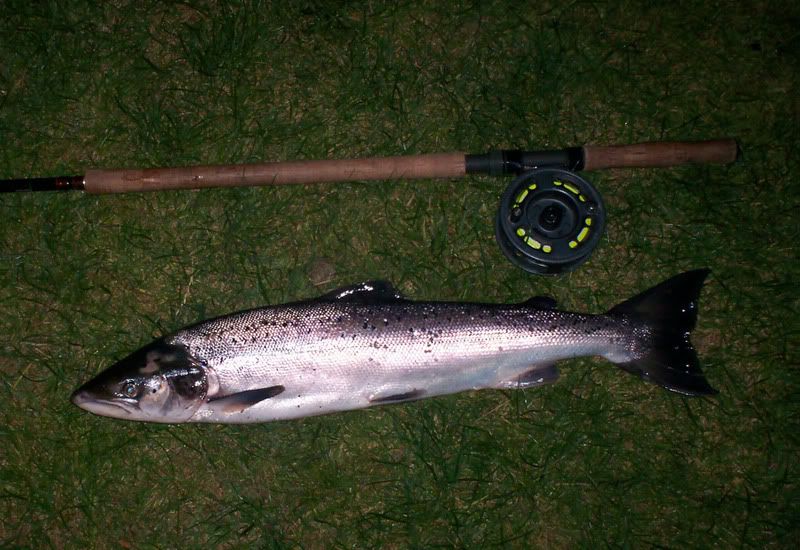
A Severn grilse caught on low water 50 odd miles from the tide. It fell for the Black prawn.
If Plan B doesn't work its back to watching the river and waiting.
This gist of this approach is taken from Hugh Falkus who describes it in his book salmon fishing pp 85/8. The only difference is that Falkus used the big tandem rather than tubes and also he didn't do the the waiting not fishing bit. The use of tubes is the product of my expereince fishing the welsh sewin rivers, while the waiting is based on 'waiting for a rise' as in the classic way of fishing dry for wild brownies (Falkus's approach was to merrily fish away somewhere else for sea trout then up sticks if he heard a fish move, but on the Severn we have no big schools of sea trout to provide such a wonderful diversion).
What normally happens is the fish either nails the fly first time or not at all. Very occassionally you might get a fish at the fifth or sixth shot after he's repeatedly shown, but not often. Changing to bigger or smaller flies sometimes works but again not often. The most annoying thing is when the fish boils as you're fly but doesn't take this is more common, and as all salmon anglers know is deeply frustrating.
I've experimented with more radical plan B's. I've tried some of the different sewin fishing approaches, a deeply sunk fly on a fast sinking line presented eye-ball to eyeball and a surface fly riffling and bulging through the top of the water, but despite working well enough for the sewin, they haven't worked for me at night for Severn salmon.
This question of having an effective plan B for when the fish either don't take straight away, or just slash or boil at your fly has been exercising my fishing brain for some time.
My variant of the Black prawn held against the dusk sky over the Severn valley.
In the springof 2007 I was on a fishing break with a couple of mates in Scotland (on the Cree and Bladnoch to be precise) anyway, in the cottage was this huge collection of Trout and Salmon magazine. Flicking through them one evening I came across this article on the black prawn fly which is specifically designed for salmon fishing at night. Flies designed for fishing for salmon at night make rocking horse poo seem common, so the pattern made an impression. I resolved to tie some up for the summer night fishing and fish them as described in the article.
The inventor of this fly is James Waltham who played an important role in the development of the sea trout snake fly. So I felt that he must be on to something, especially as he was clearly one of that small band of anglers who go fishing for salmon with the fly at night by design.
But in 2007 the river was so high that night fishing, in fact any kind of fly fishing, was impossible during the main run. Unlike most salmon rivers we need low water for fly fishing on the middle severn, anything else and the fish are up to shrewsbury and on to wales a day or so after coming in from the tide. As a result of the permanant high water all thought of tying some Black prawns had left my mind.
Eventually, come mid September the river was just about OK for night fishing, and then I remembered the Black prawn. I couldn't find the copy of T&S so I decided to see if any of the guys on the sea trout and salmon web forums could help. One guy posting as Clydebuilt came to my aid and provided a picture of the fly from his scrapbook. I'm indebted to him and he can have free fishing on the Severn for life it he ever wants it! I hurriedly tied some up and they were ready to be employed as a new Plan B should the next 'taking fish' I came across refuse to take.
So there I was sitting by the river again at dusk, watching the greens turn to grey, and counting the stars as they appeared. Then the fish moved out in the darkening river. I covered him with my trusty blue and silver tube flies, but he just sloshed at them, so back to the bank and on with the black prawn.
The point about the black prawn is that it gives you the option of a completely different presentation to the tubes. Instead of a sand eel or bait fish darting just under the surface, which is what the tube is designed to create an impression of, the black prawn is intended to be fished sink and draw, to drop down to the fishes' level and to move up again swimming in a pulsing movement like the natural shrimp. First fish down I let the black prawn swing round and drop down, lifted the rod and retrieved a few inches of line, then as I went to raise the rod again everything locked up, a head started shaking and a fish was on. The fish was eventually landed a grilse of seven pounds or so. The Black prawn had done the job. The next night it produced another.
If only every plan came together like that? But then if it did I think I would have to give up fishing.
In recent seasons I've changed the focus of my approach to night fly fishing for salmon and concentrate much more on 'travellers'. I will fish hard even with no signs of fish If I think the conditions are right for salmon to be running under cover of darkness. At some stage i'll write about this in a bit more detail.
For a few years now I've been having some success fishing large flies fast sub-surface to catch Severn salmon at night. The basic tactic is the same as that used in sea trout night fly fishing.
If the conditions are not right for travelling fish to be pushing upstream through the shallow runs then the only prospect for catching a salmon on the fly is in and around the main pools.
Messing about with a fly line in broad daylight on the glassy surface of a Severn salmon pool is not my idea of stealth, nor is plopping about in the same pool in chest waders. Much better to wait for the light to go so it camouflages the angler's movements.
What also happens when the light goes is that one or two of the salmon that are held up in the deep pool might just 'stretch their fins' as it were. They might drop back into the shallower water of the tail, or sneak up into the neck for a little swim around. It is then that there is a chance of catching one on the fly.
If alone on a Severn salmon pool at dusk I settle down in a good vantage point by the head or the tail and watch the water. No fishing. I just while away the time watching and listening to the river, smoking the odd cig, watching the heavens, spotting constellations and counting shooting stars. It is really hard at moments like this down by the river at dusk to believe I'm only 25 miles from the centre of Birmingham.
What I'm waiting for is the sound, and if I'm lucky the sight of a 'taking fish': a fish in something like hunting mode, cutting through the top layers as if after bait fish.
What I ignore is the crashes and splashes emanating from the big fish flopping about in the main body of the pool, behaviour almost like someone tossing and turning in their sleep.
As soon as I hear a 'taking fish' move I'm at the ready.
I give the fish the Hugh Falkus obligatory smoking break.Why? I don't know, but it's a case of any excuse for an addict I suppose, and it certainly helps calm the nerves. When I've finished my smoke I then make my way as quietly as I can into the water just above where the fish moved. The next few minutes are intensely exciting. Because any second now I could be into a silver bullet trying to get back to sea. After a cast or two to make sure everything is working right I will cover the fish. If I don't make contact within a few casts I retire, execute plan B which is a change to a bigger or smaller pattern and try the fish again.
A Severn grilse caught on low water 50 odd miles from the tide. It fell for the Black prawn.
If Plan B doesn't work its back to watching the river and waiting.
This gist of this approach is taken from Hugh Falkus who describes it in his book salmon fishing pp 85/8. The only difference is that Falkus used the big tandem rather than tubes and also he didn't do the the waiting not fishing bit. The use of tubes is the product of my expereince fishing the welsh sewin rivers, while the waiting is based on 'waiting for a rise' as in the classic way of fishing dry for wild brownies (Falkus's approach was to merrily fish away somewhere else for sea trout then up sticks if he heard a fish move, but on the Severn we have no big schools of sea trout to provide such a wonderful diversion).
What normally happens is the fish either nails the fly first time or not at all. Very occassionally you might get a fish at the fifth or sixth shot after he's repeatedly shown, but not often. Changing to bigger or smaller flies sometimes works but again not often. The most annoying thing is when the fish boils as you're fly but doesn't take this is more common, and as all salmon anglers know is deeply frustrating.
I've experimented with more radical plan B's. I've tried some of the different sewin fishing approaches, a deeply sunk fly on a fast sinking line presented eye-ball to eyeball and a surface fly riffling and bulging through the top of the water, but despite working well enough for the sewin, they haven't worked for me at night for Severn salmon.
This question of having an effective plan B for when the fish either don't take straight away, or just slash or boil at your fly has been exercising my fishing brain for some time.
My variant of the Black prawn held against the dusk sky over the Severn valley.
In the springof 2007 I was on a fishing break with a couple of mates in Scotland (on the Cree and Bladnoch to be precise) anyway, in the cottage was this huge collection of Trout and Salmon magazine. Flicking through them one evening I came across this article on the black prawn fly which is specifically designed for salmon fishing at night. Flies designed for fishing for salmon at night make rocking horse poo seem common, so the pattern made an impression. I resolved to tie some up for the summer night fishing and fish them as described in the article.
The inventor of this fly is James Waltham who played an important role in the development of the sea trout snake fly. So I felt that he must be on to something, especially as he was clearly one of that small band of anglers who go fishing for salmon with the fly at night by design.
But in 2007 the river was so high that night fishing, in fact any kind of fly fishing, was impossible during the main run. Unlike most salmon rivers we need low water for fly fishing on the middle severn, anything else and the fish are up to shrewsbury and on to wales a day or so after coming in from the tide. As a result of the permanant high water all thought of tying some Black prawns had left my mind.
Eventually, come mid September the river was just about OK for night fishing, and then I remembered the Black prawn. I couldn't find the copy of T&S so I decided to see if any of the guys on the sea trout and salmon web forums could help. One guy posting as Clydebuilt came to my aid and provided a picture of the fly from his scrapbook. I'm indebted to him and he can have free fishing on the Severn for life it he ever wants it! I hurriedly tied some up and they were ready to be employed as a new Plan B should the next 'taking fish' I came across refuse to take.
So there I was sitting by the river again at dusk, watching the greens turn to grey, and counting the stars as they appeared. Then the fish moved out in the darkening river. I covered him with my trusty blue and silver tube flies, but he just sloshed at them, so back to the bank and on with the black prawn.
The point about the black prawn is that it gives you the option of a completely different presentation to the tubes. Instead of a sand eel or bait fish darting just under the surface, which is what the tube is designed to create an impression of, the black prawn is intended to be fished sink and draw, to drop down to the fishes' level and to move up again swimming in a pulsing movement like the natural shrimp. First fish down I let the black prawn swing round and drop down, lifted the rod and retrieved a few inches of line, then as I went to raise the rod again everything locked up, a head started shaking and a fish was on. The fish was eventually landed a grilse of seven pounds or so. The Black prawn had done the job. The next night it produced another.
If only every plan came together like that? But then if it did I think I would have to give up fishing.
In recent seasons I've changed the focus of my approach to night fly fishing for salmon and concentrate much more on 'travellers'. I will fish hard even with no signs of fish If I think the conditions are right for salmon to be running under cover of darkness. At some stage i'll write about this in a bit more detail.
Monday, 12 March 2012
2011 season overview
I hope people find this useful. I've compiled it from the T&S reports and added a few bits .
The season started with anglers hoping that the high water and milder temperatures through most of January had drawn a sprinkling of fresh fish in to the system.
Alan Jones from the Environment Agency provided some interesting information on the spawning run from the fish counters. In total 2112 salmon went through the fish pass on the Teme at Ashford between the end of the season and January 17th. 61% of these fish were classified as small salmon (under 8lb I believe) and 62% took the pass after December 1st, suggesting that the spawning run came quite late this winter.
Alan also reported salmon seen still running the Teme at Ludlow over the wekend of January 22nd and 23rd. The Ashford fish pass is by-passed during high flows, when fish can take the weir itself, so the actual number of fish making it to the redds on the upper river is no doubt substantially higher. A significant number of fish have also spawned in the middle and lower Teme below Ashford weir. This is very encouraging news.
The reports from the Tanat counter were less encouraging. Only 245 fish were reported as of the middle of January. If this figure is accurate it represents the worst upstream count in the last decade. However, it is known that the counter was inoperative over the ten days up to December 5th and there are as yet no January figures available.
There has also been an issue over how effective the counter is during high flows. The EA have declared that the data from the Tanat counter is flawed. So we can't be certain that the count is a true reflection of the number of fish running this important spawning tributary.
High water for much of February meant that very little fishing was done. The first salmon of the season, a bright 14lber, was caught by Paul Harris at Diglis on the 18th. It fell for a Devon minnow. There were a few other reports of fish hooked but lost, so at least some fish were moving into the system.
Salmon anglers were pleased to see the high waters of February receding as March progressed. The lower river beats started to produce a trickle of fish. Successful anglers included Harry Dawson (16lb and 17lb), Sam Salisbury (12lb and 13lb) all on Devon minnows. I’m particularly pleased to report a couple of fish from traditional early season beats above Worcester that have been very lightly fished over recent years. One of these was a lovely 18lb specimen caught by John Bailey on a thirty year old minnow from his father’s collection. The other fish from this area weighed in at 12lb 8oz.
![]()
Alan Shufflebotham's fly caught 19lber
The highlight of the early season was a magnificent 19lber caught on the fly from the lower river by Alan Shufflebotham. The fish was Alan’s first ever from the Severn on the fly and fell for a one inch cascade tube fished on a fast sink tip shooting head. Alan who is 80 years young is deservedly delighted with his achievement. Along with one fish from the tidal reaches at 14lb this put the total for the first three weeks of March up to eight. Unfortunately with no more rain the river had shrunk to very close to summer low.
Salmon fishing on the Severn was not helped by the dry weather in spring. The river varied from low to very low in March, April and the first half of May. In that time we had just two small and short-lived rises in river levels. The first, at the end of March, saw a significant spate on the Vyrnwy which then put about a foot on the middle and lower Severn. The second rise came in early May and only really impacted below Stourport and raised water levels by just 8 inches or so. It was made up mainly of road wash entering the river via the Worcestershire Stour.
The conditions just did not exist for Spring salmon to spread widely through the system. This requires a series of regular pulses of water (at a good height and over a sustained period of time) to encourage the fish to run the 220 miles of river. The result of one of the driest springs on record was that salmon fishing became restricted to the lower river.
The sad fact is that only two fish had been reported from above Stourport by the middle of May. This has made 2011 one of the worst ever spring salmon seasons for anglers fishing in Shropshire and the Welsh borders.
The heat-wave of mid April exacerbated this situation as it kicked off an algal bloom that choked the middle and lower river of oxygen, and made the small numbers of fish that had penetrated above Stourport dour and very difficult to tempt. Flows became so low that in early may the EA was posed to start fish rescue operations on the upper Teme. Thankfully rain in the first weekend of May postponed this.
In the eight weeks from mid March till mid May sport was effectively restricted to a few short sections of well oxygenated water on the lower river weir pools. Fish caught elsewhere being very much the exception.
The most successful angler during this period was John Love who landed a magnificent fish of 29lbs 8ozs and another of 16lbs on the same day in early May, as well as a number of other fish in the 15lb class in the preceding weeks. Two anglers caught there first ever Severn salmon in April. Jason Tapp had a fish of 14lb and Phil Filer one of 8lb – both on the spinner and both from Diglis. Jason and Phil are rightly delighted as a Severn spring salmon is an achievement for any angler and both have certainly put in the hours to deserve such a fish.
John Love's 29lb 8oz fish
Other anglers that were successful during late March, April and early May include Toby Fletcher with fish of 18llb and 10lb on a black flying, Brian Knight with a fish in the 20lb class on spinner, Mark Saunders with a 10ber on the Devon minnow, Sam Salisbury with a 10lb fish on a home-made plug and Ellis Brazier with a fish of 11lb 8oz on a Rapala. Craig Guy did particularly well with a number of good spring fish up to 16lbs on the spinner, plus a fly caught fish from a lower river weir pool in early May. Two other fish came to the fly at this time with John Bailey (middle river) and yours truly (tidal) being the lucky anglers.
Returning a fly caught fish to the tidal river
Catches held up relatively well given the low flows and low angling effort. March 2011 was good but the spring as a whole (February, March, April) was well below the five year average. The other side of this though, was that the catch was the best we’d had in a low water spring for some time, suggesting that the run was quite good and that there were significant numbers of fish out in the estuary or in the lower river waiting for a rise in water to enter the river.
The second half of May and the first two weeks of June saw a continuation of the pattern of salmon catches that we’d seen so far, with most of the action confined to the lower river.
Many of the regular rods on the lower river have had some success with John Love, who added to his tally of 20lb plus fish with a couple more, and Craig Guy being amongst the most successful.
It was particularly pleasing to report success for Rob Taylor who landed a fish of 14lb from the lower river in early June. Rob is a veteran of the Severn, having first fished the river in the 1950’s and is a member of that elite band of anglers who has a Severn 30lber under their belt. After the fall off in catches in the late 1990’s Rob drifted away from the Severn, but following a number of desperately disappointing seasons on the middle Wye, when he hardly saw a fish, he has now returned to his home river full of excitement and youthful enthusiasm.
Rob Taylor with a classic 70's Severn springer
Thankfully sport has not been entirely restricted to the lower river weir pools.
A couple of small rises has helped distribute fish more widely. Cheering up the anglers no end. This e-mail I got in early June from a committee member of one Teme club summed up the mood of optimism:
'Hi Tom,
Just to say I noticed on Tuesday evening the gathering of Salmon awaiting to go up the Teme had finally made a dash for it after the Sunday rainfall. The River did rise a few inches and not sure how far they have travelled upstream, but they certainly were on the move and all very clean fish.
I lost a very big fish sunday evening, i saw it but could not stop it.
Lets hope we get sufficient rain this year to keep everyone happy (pref every night for a month+)'
By late May more fish were being seen in the pools and runs above Shrewsbury and in the Vyrnwy, but anglers have not been having much luck trying to catch them. One theory for this lack of success is that many of the fish that have finally arrived in the upper river have been in fresh water for some time, perhaps since April, and the low flows have not favoured tempting them.
However, in the middle river things have been a little better. Dave Hughes caught his first ever Severn salmon on the fly in May, and then followed it up with another a few days later. The fish weighed 14lb and 10lb respectively. The largest came from below Shrewsbury, while the other came from below Bridgnorth. Both fell for a small yellow and orange plastic tube fly. Dave is very happy indeed at his achievement and rightly so. He also caught a fish of 10lb or so from Diglis on a tiny Devon minnow later in the month.
John Bailey yet again had success on the fly catching and releasing a pristine 18lber from below Bridgnorth in early June. John’s fish fell for a small Usk Grub fished during a dawn raid in dead low water. It shows that even when the conditions seem to be against you a stealthy approach by the fly fisher can still pay dividends. Along with another couple of other fish to the fly from the middle river it has been a reasonable month for that small band of dedicated fly fishers on the Severn.
Modern steel putcher baskets - out of action
The start of June brought the news that the main Putcher rank in the estuary would not be working in 2011. Another smaller rank was stopped too and the one remaining was given a catch limit of just 29 fish. The result is that another 800-1000 fish will make it to the spawning beds on the Severn, Wye and Usk and at a cost which is just a fraction of producing the same number of fish in a hatchery. This shows that the strategy pursued in the 2010 buy-out by the Wye and Usk Foundation and supported by the Severn Rivers Trust is bearing fruit. So far, so good. All those clubs and individuals that contributed to the buy-out can hold their heads up, while those who kept their hands in their pockets (including the club controlling the most productive fishery on the Severn) should examine their conscience. The tiny minority of armchair internet pot stirrers who created division and suspicion by talking of fraud and accusing supporters of the buy-out of mis-selling and who even called on anglers not to donate to the initiative should hang their heads in shame. In future we can hope that they will be a little more hesitant before assuming the worst of those taking practical action to improve salmon stocks.
The good runs (by recent standards) of salmon that we saw in late May and early June continued in to the second half of the month, but seemed to slow down in July.
Fish were reported from most sections, but the bias has been very much towards the lower and middle river. Catches on the upper river, Teme and Vyrnwy could only be described as disappointing.
Successful anglers included Dave Hughes with fish of 13lb, 9lb and 6lb on the worm from the middle river below Bridgnorth. Jason Tapp added to his tally with two fish of 8lb on the worm from the lower river, as did John Love with a lovely sea liced fish of 16lb on the spinner and two grilse of 6lb and 4lb on the worm. Toby Fletcher had a bright fish in the mid teens from the lower river on a prawn, while Craig Guy landed a 12lber on the worm. Ian Bott opened his account with fish of 10lb and 15lb on spinner and worm respectively. Harry Dawson fished hard on falling water on the upper river and Vyrnwy and was rewarded with fish of 10lb and 6lb on the worm.
10lb of Shropshire silver for Jason Newton
Though worm and spinner have been the preferred methods some fish have still come to the fly despite the often heavily coloured water. I’m particularly pleased to report a first ever fly caught Severn salmon for Jason Newton. The fish, a pristine 10lb bar of silver, fell for a simple hair wing tied by Jason himself and presented using classic floating line tactics. Those Severn anglers that know him will be well aware of the dedication Jason has shown in his quest for a fly caught salmon from the river and will be delighted for him. We all know that it will be the first of many.
I also managed a couple of fish around the ten pound mark on the fly in June from the middle river and I’m sure if more anglers persevered with the method more fish would fall for it. I have to admit that I’ve also elected to fish the worm as conditions have dictated and that has also added a couple of fish to my tally.
The general mood on the lower and middle river is that we’ve had a good run this year, particularly, of the two-sea-winter salmon that enter the river in May and June. However, the one worrying trend has been the lack of fish from the upper river and Vyrnwy. Earlier in the season this could be explained by the extended low water conditions, but since mid June we’ve had a number of small spates which it could be assumed would’ve been more than enough to allow fish to penetrate as far up the system as they desire.
I’ve discussed this issue with experienced anglers who fish the upper river regularly and a number of possible causes have been identified. These include: reduced flows due to abstraction; the fall in the number of fish entering the system early in the season when higher flows make it easier for the fish to get up river; and the ban on bait and taking fish before June 16th. Another reason put forward is that the rain came just too late and that the majority of the sopring and early summer run had already settled in the lower and middle river and were not going to move upstream until much closer to spawning.
Taken together these factors combine to deter anglers and to drastically reduce the numbers out on the banks of the upper river and tributaries. As a result the catch from this section continues at very low levels.
The second half of July and early August saw Salmon sport slow down on the Severn. Fish continued to be caught, but in reduced numbers in comparison to what we were seeing in May and June.
Returning a bright fish caught on the light line worm
It was great to report another angler with his first ever Severn salmon on the fly. Steve Dean was fishing the last few inches of a falling freshet and hooked a fish of 9lb or so from the middle river on a sink tip shooting head and size 10 cascade. Steve is delighted with his fish and hopefully his success will encourage other anglers to try the fly.
Other successful anglers this month have included John Love with fish of 10 and 12lb on the worm, Craig guy with a grilse of 5lb or so and Alan Duinsmore with a couple of fish from Shropshire on the worm. I also managed another fish on the fly around 10lb, this time in low clear water using a floating line, long leader and a tiny feather wing fished fast.
A series of small spates in late July ensured that at least a few fish penetrated the headwaters, with the first reports coming in of fish above Newtown on the Severn and Meifod on the Vyrnwy. The regular freshets lso helped fishing below Shrewsbury with 15 or so fish falling to a handful of anglers from Atcham downstream in the period since the bait fishing started. A few more fish have come from beats up to Melvereley, but still catches from the river above Shrewsbury could only be described as disappointing.
The fluctuating river levels didn’t help fishing in the lower river, as the regular pulses of high water combined with good tides created optimum running conditions in late July. This, combined with the fact that, as one experienced Severn rod put it, ‘the little grilse don’t hang around’, has led to very mixed reports from the lower river. I was told of days when exceptional numbers of fish have been seen taking the weirs, but know that there have been many other occasions, when very little at all has been seen.
My own experience was that there have been taking fish about even if not that many have been showing. On one of the falling spates in July I fished three short sessions on consecutive days and saw just a couple of fish, but despite the apparent lack of fish I still landed a 6lb grilse for another angler, lost a grilse myself and caught and released a bright summer salmon of 10lb or so. If I’d been listening to the tales of doom and gloom coming down the bank-side telegraph I wouldn’t have bothered fishing.
As we moved in to August rising water temperatures put a dampener on sport. By August 4th the EA measuring station at Bewdley was recording 21C at midnight! In these conditions, and irrespective of the opportunity provided by big 9m plus tides, the fish in the estuary would be far happier staying there rather than trying to run the river and they were no doubt waiting for a drop in water temperatures and an increase in flows. As were the anglers.
August turned out to be a slow month for salmon sport on the Severn. Low flows, high water temperatures for the first part of the month, and a significant reduction in the number of rods out led to a fall off in catches.
A few fish were caught from the lower river with the top rod John Love who landed seven grilse between 5lb and 8lb over eleven days mid month. John’s fish fell for either worm or shrimp fished as naturally as possible on a light rig. John also released a number of larger colouring multi-sea-winter fish as did a few other anglers.
Another middle river summer salmon to the light line worm about to go back
One or two fresher summer salmon were still trickling through to the middle reaches, but not many. I was lucky enough to catch and release one on the light line worm that was still bright and was estimated in the 13-15lb class.
A small fly caught grilse from the middle river one of the 'night runners', photo taken the morning after.
The grilse were appearing in the middle river too, but not in huge numbers and seemingly running at night. John Bailey added to his fly caught total with a very fresh fish of 6lb or so mid month. The fish, which came from the middle reaches, fell for a small Usk Grub fished on a full floater and a long leader in dead low water. John tells me that he waited for dull overcast conditions before fishing – a wise move given the very low and clear river. John is also a believer in taking a good few steps between casts in low clear water to ensure that the fish doesn’t get to see the fly too many times before it is in its taking zone. Sound tactics for anyone who wants to tackle Severn salmon on the fly in tough low water conditions. I also managed a bright fly caught little grilse of 4lb or so on a small blue and silver tube from the middle river by using an alternative low water tactic: sea trout style night fly fishing.
Further up river I’ve heard of a few more fish coming to the bank – mainly to the worm. Among the successful anglers was Duncan Rawull with a fish of 10lb from the Vyrnwy.
From the second week of September salmon catches finally started to pick up on the upper river.
Successful anglers included: Rob Davies with a silver 8lber from above Newtown on a black and silver rapala, Harry Dawson 8lb, Duncan Rawull 4lb and 9lb and Ellis Brazier 10lb all on the worm from the Vyrnwy. The fish were finally moving up the system in response to the two good rises we had in September.
The largest of the rises came in the third week of the month and led to reports of good numbers of fishing making their way up from the tideway and over the weirs on the lower river. Interestingly a significant proportion of these fish were coloured and in the 10 to 15lb bracket, suggesting that large numbers of summer salmon have been holding in the lowest sections of the river and have been unwilling to run given the lack of a decent 3ft plus spate through most of the summer.
The lower river fisheries were able to take advantage of the water with a handful of clean autumn salmon and grilse reported as well as higher numbers of colouring fish. John Love again came up trumps with 5 fish for the month including two in the ten pound bracket and three grilse. Craig Guy added to his tally too with fish of 11lb and 12lb on the small Devon and flying C.
Fly anglers on the middle river also managed to take advantage of the conditions. John Bailey landed a fish of 9lb on a size 10 Usk grub fishing a falling water towards the end of the month, and then added to his total with a fish of 8lb or so on a tiny size 16 cascade in a howling gale and heavy rain in early October. I also managed a couple more fish on the fly, both grilse weighing 5lb and 7lb respectively, and falling for a size 14 black bear flamethrower at dusk and a two inch black, red and silver tube after dark.
John Love (right) and Alan Shufflebotham with their prizes.
After the season was over an awards evening was held for the Shakespeare Oracle XT salmon Competition. The prize (an oracle XT salmon fly rod) is given for the largest salmon caught and released from the river. It is an attempt to promote the river as a salmon fishery and the voluntary release of our bigger salmon. There were two winners; John Love for a fish of 29lbs and a special award for Alan Shufflebotham for the largest fly caught fish.
Sunday, 11 March 2012
The grumpy faction's myths and prejudices
Anglers being anglers exaggeration, gossip and plain untruth spreads quickly in our ranks. The result is that most angling communities have a set of urban myths that are repeated so often that people believe them to be true. Severn salmon anglers are no different. Many of these myths come from the 'doom and gloomers', what I would call the grumpy faction, people who only seem to be happy when they've got something to moan about.This is the first of a series of articles designed to debunk some of these myths by looking at the facts and coming up with a more balanced view.
Myth number 1 'Historically the Severn produced far more fish than the Wye.'
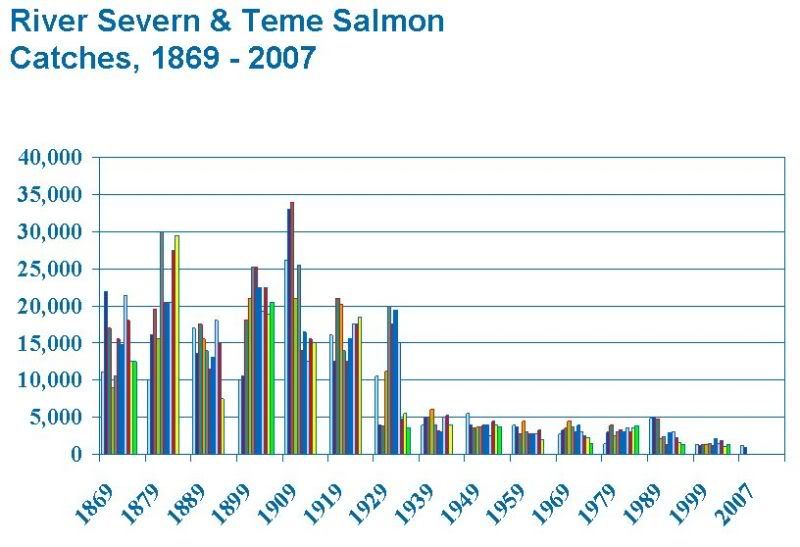
This claim is something you hear repeated on the bank from time to time. It is used to illustrate the extent of the decline in salmon stocks on the river. The evidence that is usually cited to back up the claim is the fact that the total reported catch from the Severn district reached a peak of 33,000 in 1911.
What this myth ignores is the fact that an awful lot of Wye and Usk fish were counted as part of that ‘Severn’total. The Severn district net and fixed engine catch actually consisted of a mix of fish from the Usk, Wye and Severn caught in the Severn estuary, plus a much smaller number of fish caught from the river proper. Historically all net and fixed engine catches in the estuary down to the Wye mouth were counted as part of the Severn total, this reporting procedure continued to the present day.[i]
Back in the late 19th century, J. W. Willis Bund chair of the Severn Board of Conservators was well aware of this mixing of the stock from the three rivers. This is what he said about in his book ‘Salmon problems’ published in 1885:
‘In the lower Severn there are, no doubt, different kinds of Salmon met with. There is the ordinary Severn fish; a longer and lankier fish, that is said to be a Wye fish; and a short thick fish that the fishermen speak of as "Uskers”. I have not met with either of the last two kinds above Tewkesbury weir, and I cannot say if the names locally assigned to them are right. Salmon from the same river,present such varying forms, that it is almost impossible, even for the most experienced, to say positively that such and such fish belongs to a particular river. ‘
‘All that can with certainty be said, is that a portion of the catch of the Severn are bred in the Wye,that the fish taken as far as the Severn bridge [ii]probably belong to either river; but I have no evidence to show that if a fresh came down the Severn, the Severn fish would alone ascend, and leave the Wye fish in the estuary waiting for a Wye flood.’
Willis Bund believed that the only way to get a better picture of the extent of the mixing of stocks in the estuary was to mark estuary caught fish and then release them and monitor any recaptures.
‘This is one of the points that, if marking fish were carried out on a large scale, might be cleared up. This fact should also be borne in mind in reading the reports of the Inspectors of Fisheries when they institute comparisons between the Severn, Wye, and Usk, and state that the Wye take has increased, and the Severn fallen off, and wonder how it is to be accounted for, as it is by no means clear that the take of the district has fallen off, for the increase of the Wye in tidal water may represent Severn fish, or vice-versa. When the rivers has a common estuary, and the districts are divided by an imaginary line, it is impossible to say what fish rightly belong to each river. ‘
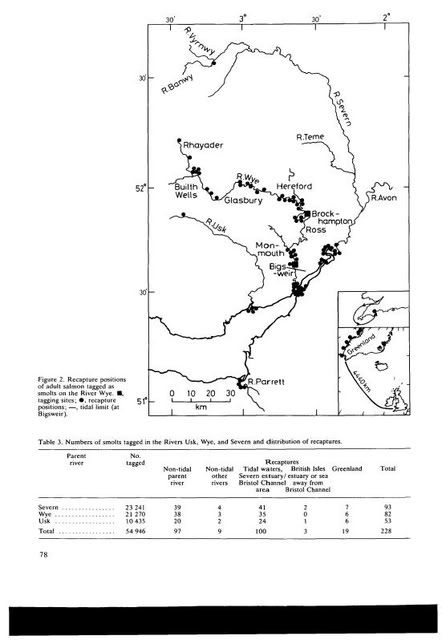
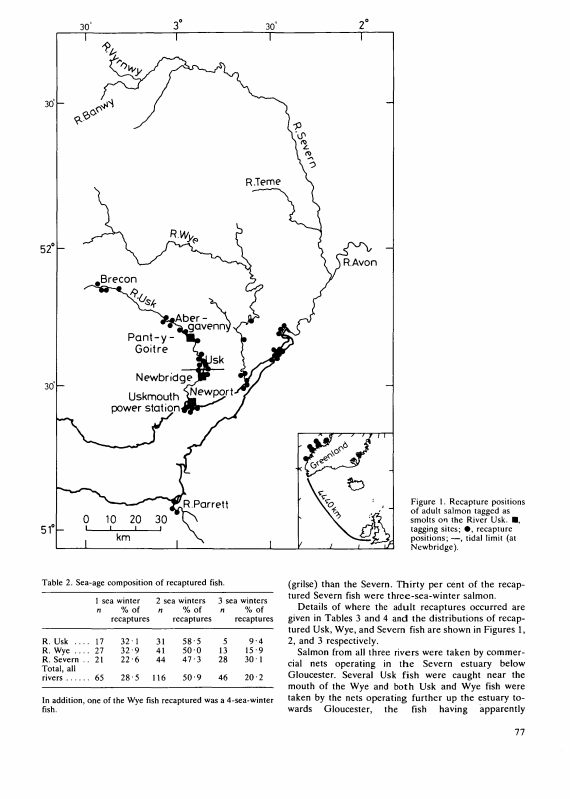
A smolt tagging study of the three rivers was finally carried out from 1958 to 1964. It concluded that: ‘the commercial nets operating in the upper reaches of the estuary below Gloucester and above the confluences of the Usk and Wye caught salmon from all three rivers indicating that some of the Usk and Wye fish returning from the sea had overshot their parent rivers.’[iii] The maps showing the capture points of smolts tagged from the Wye and Usk are shown below.
T he study suggested that 31% of the Severn net and fixed engine catch came from the Wye and 24% from the Usk. This probably overestimates the percentage of Severn fish in the catch at that time as a disproportionate amount of the smolts tagged came from the Severn.
If tagging had been carried out in proportion to the rod catch from each river then the Wye and Usk would have produced many more tagged smolts in the Severn catch.
The study showed that it wasn't that the Severn estuary nets and fixed engines caught the occasional Wye and Usk fish, salmon from those two rivers made up a majority of the catch.
Pretending the 'Severn' net catch is a measure of fish spawned in the Severn and returning to it makes no sense.
It is important not to forget the scale and scope of the Severn estuary fishery. This was a massive industrial scale operation that in the late 19th century accounted for 267 fish for every one caught on rod and line from the Severn. See The Severn salmon fishery in the 19th centuryThe fact that the Severn estuary catch peaked in 1911 after netting was severely restricted on the Wye from 1901 isn't a coincidence. The removal of the nets allowed more Wye fish to return and spawn, this in turn boosted the Wye rod and Severn net catch.
It is ironic that in the peak years of the Severn district catch most of the salmon may well have come from the Wye.
No doubt before the industrial revolution a more or less unpolluted Severn may well have provided spawning grounds for more salmon than the Wye, but not since then.
Myths and prejudices to be covered in future articles include: 'With the putchers off we should be catching a shed load more fish' and, 'Without weirs the Severn rod catch would fall'
'
[i] ‘Some of the Putcher ranks operated in the Severn estuary, have been owned by the Wye Fishery Authority and were leased from them on an annual basis. Catches made by these implements have been recorded with the rest of the Severn catch throughout the review period’ Fisheries data report number 38, Salmon and migratory trout statistics for England and Wales 1951 – 1990, MAFF Lowestoft 1995.
[ii] The Severn bridge referred to was the railway bridge from Sharpness to Lydney
· [iii] The migrations of salmon (Salmo salar L.) from three rivers entering the Severn estuary, by A Swain, http://icesjms.oxfordjournals.org/content/40/1.toc
Sunday, 4 March 2012
Advice to someone thinking about starting up fly fishing the Middle Severn
I regularly receive requests for information from midlands based anglers thinking of taking up fly fishing on the middle Severn. Here are a few pointers.
1. Forget the 15ft rod and 10/11 lines.
There really isn’t any need for heavy kit on the Severn. Even with a few feet on and conditions that require big heavy tubes a 13/14ft rod and 9/10 lines are all you need.
Most fly fishing on the middle river is done at or towards low water. That means fishing glassy glides and pool tails. In these circumstances lighter lines are a better bet. It is important to think stealth, not ‘whamming it out’. My low water double handed rods range from 14ft to 12ft and I use 8/9 or 7/8 lines with them. I also have an 10ft 8 weight single hander which I fish with 7 or 8 weight lines and occasionally a 6 weight. My favourite low water line is a homemade shooting head constructed from the front portion of an 8/9 floating Spey line with a very fine gradual front taper. This allows for delicate presentation and if I want to get the fly down a little I use trout (not salmon) poly leaders of either 5ft or 10ft. On low water I also use longish leaders so the poly leader and hook length will be somewhere between 18ft and 25ft long in total. This set up is designed to give as delicate a presentation as possible while still using a rod with the backbone to land a good sized salmon quickly.
I’ve seen plenty of Severn salmon spooked by heavy 10/11 lines on low clear water. One day sticks in the memory. I was sitting on the river bank watching a guy repeatedly crashing a 10/11 shooting head without poly leader on to 3ft of clear glassy glide. When his casts got within about 20ft of a known lie a fish rocketed out of the water, turned tail and ran back to the deep pot of the pool breaking surface a couple of times as it went. ‘There’s a few fish running today’ the angler bellowed to me across the river. He didn’t seem to recognise that they were running from him. Instead he spent 30 minutes repeatedly covering the same now empty spot where the salmon had come crashing out of the water.
2. Go fishing not casting
It amazes me how many people think it is perfectly OK to practice their casting over water holding salmon. It just isn’t fair to people trying to catch them. I remember one season when an angler took up station on a particular holding pool to practice his casting from the bank. He stayed in the same place for hour after hour, day after day. After a few weeks you could see the gap in the bank side vegetation behind his right shoulder where his D loop had acted like a garden strimmer. Fish just wouldn’t settle in the lies his line covered and the only fish caught from that pool that season were holding out of his range.
Modern Spey casting has given anglers a wide range of casts that are worth learning and will get us out of jail in more or less any circumstances. However, some of these casts are not exactly delicate. I’m thinking especially about waterborne anchor casts like the various modern snaps and pokes and also the classic double Spey. Don’t use these casts when you’re trying to cover low clear glassy glides. The noise created by ripping the line off the water is enough to spook the fish. Use kiss and go casts like the single Spey or snake roll, or better still - and if you’ve got the space behind you - use the overhead cast. And unless there is plenty of water on don’t use casts where you lay the line out on the water in the direction of the cast and then single Spey and shoot.
3. Fish deep by all means but avoid snagging up
I’ve found that a fly fished deep and fast can be highly effective on low clear water. It is a very useful alternative tactic to the usual subsurface presentations. However on low water it is important to fish deep and fast. Or at least to make sure that your fly is not continuously dragging bottom. If you don’t you’ll find your hook attached to a rock, a spawning barbel’s back, or you might even snag a salmon.
This might seem too obvious to be even worth stating, but unfortunately I’ve seen plenty of anglers who are clearly unaware of it. To the inexperienced a slow tightening of the line as it swings across the pool, followed by a heavy bump could be a signal that a salmon has taken your fly. However, if you’re fishing with a type 2 or heavier sink tip in just 3 ft of medium paced water and you aren’t working the fly, then it is much more likely to be caused by hooking a boulder (the slow tightening) and then dislodging it (the bump). Foul-hooked barbel can give a similar indication, and if they then take off broadside to the current may even convince the novice that they have hooked a salmon. Though it is comical to watch an angler lift the rod and shout ‘fish on’ and then reel in a rock fish, the serious problems caused by this type of fishing is that it risks foul-hooking fish, spooks everything in the pool and spoils the sport for others. Lines raking the pool spread panic in low clear water. If the angler gets repeatedly snagged on the bottom then the resulting taught line can bang into fish and it will certainly disturb them. Fish deep by all means, but if you keep getting snagged up make the necessary changes to stop it.
4. Don’t fish with the sun at your back
Much of the middle Severn flows north west – south east, or between that and north - south. That means that fly anglers fishing in the evening during the key months of May, June and July are faced with the problem of the setting sun shining directly in to the fishes’ eyes. Salmon don’t have eyelids or wear sunglasses. You can waste hours on evening after evening trying to get them to take a fly in these circumstances.
5. Take up night fly fishing
Salmon will take a fly well at night and on low water are more likely to be found in good fly runs at night than during the day. They seem to move out of the pools and in to the runs and tails as the light fades and will continue to push upstream under cover of darkness even when all upstream migration has ceased during the day. Don’t wait for perfect gin clear conditions for night fishing, as long as you can make out your boots when the water is up to your privates it is clear enough for the salmon to see your fly.
6. Don’t bother fishing when an algal bloom is on, or when the water gets too hot
Most years at some time in the late spring a major algal bloom takes hold of the middle Severn. This reduces visibility to inches sucks the oxygen out of the water and chokes the fish. Residents might be showing all over the place, but they are distressed fish. Trying to catch them is a waste of time. The same is true of high water temperatures over 20c – don’t bother fly fishing. You can sneak out the odd fish when the water is just below this temperature, but it is tough going. Once the river is down to 15c or so sport improves dramatically. When the water is very warm the only chance of a fish is from the oxygenated water of the weir pools on the lower river.
7. Identify a couple of holding pools and spend time learning them properly
The Severn is a working man’s salmon river. You can’t expect to get everything on a plate, the anglers tend to be tight lipped about where to find a fish. However, if you are prepared to put in the effort to do most of the work finding the fish yourself the rewards can be great. There are plenty of good holding pools on the middle Severn. You can get access to these on a club book for a very reasonable price (last season my middle Severn fly caught fish cost me less than a fiver each in terms of permit money). Join a few clubs, walk the river, if you stumble across a salmon angler don’t expect them to tell you much, talk to coarse anglers and ask them about where they’ve seen salmon. This will give you enough information to identify some areas to start with. Once you’ve found these deep holding pools start fishing the runs and tails and keep a close eye on the EA river gauges. Over time you will build up an understanding of where and when to fish.
A final word.....
The Severn is a challenge, but it is seriously under-fished as a salmon fly fishing river. Give it a go, put in the work and you may be pleasantly surprised.
Subscribe to:
Posts (Atom)