Sunday, 24 June 2012

30lb Severn salmon

Here are a couple of pictures of Paul Harris's 30lb 8oz, 44 inch long salmon from the lower river.


This is now the front-runner to win the Shakespeare Oracle XT Severn Salmon competition for the biggest fish caught and returned from the river in 2012. A full report of the details surrounding the capture will appear in the next Severn report in Trout and Salmon magazine.

Monday, 18 June 2012

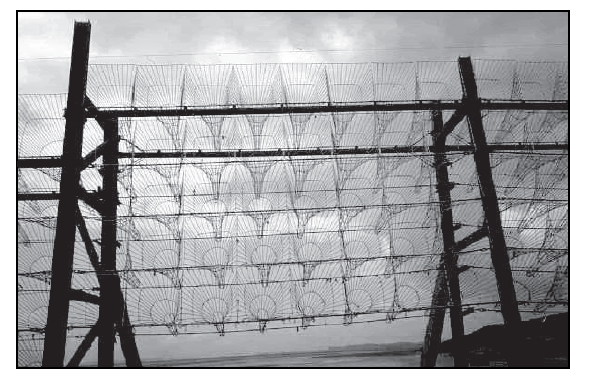
Industrial scale salmon netting ends in the Severn Estuary

Using powers given to them under the Marine Bill the Environment Agency have imposed quotas on the net and fixed engine fishery in the Severn Estuary.

This year the quotas have been set at thirty fish per putcher licence, two fish per seine net licence and three fish for each lave net licence. This effectively means the end of the industrial scale commercial salmon fishery in the estuary. There has been no compensation paid as part of this package.

What's particularly important about what's happened is that it has been achieved at a fraction of the cost to angling interests of some other buy-outs (for instance the buy-out of a smaller fishery in the estuary of the Welsh Dee cost a massive £350,000). This is ironic considering the furore created by internet pot stirrers and armchair conservationists over the £35,000 paid jointly by angling interests and the EA in 2010.

The option of allowing a limited heritage fishery to continue ensures equity between rods and nets and is preferable to a complete closure of the net fishery through state action. A spokesperson for the  EA Midland region explained to me that it is important to remember that it is the state of stocks in the Wye (as opposed to the Usk or Severn) that is the driver for the reductions. Therefore, the quotas have been calculated by the EA to recognise the reality of the mixed stock fishery and ensure that no more Wye salmon are taken by the estuary nets and fixed engines than would suffer post hooking mortality under a regime of 100% catch and release.


Wednesday, 13 June 2012

The Shropshire Spring

The good flows this spring have meant that for once anglers on the upper river have had the best of the sport.
Here are a few photos.


Ellis Brazier with a fish of 21lb 8oz


And another at 16lb
Allan Richards with a very fresh fish for the Shrewsbury area.
Al and Ellis have had a great season so far with all of their fish coming to Abu salmo seeker lures.


The first fly caught fish of the season fell to Craig Chettwood and weighed 13lbs.


The second was caught by Steve Morris above Shrewsbury. His first ever on the fly.

Thursday, 24 May 2012

Severn redd counts 1975-2004

I thought it might be interesting to look at the official EA redd counts on the Severn from 1975-2004. The picture this presents is of an increasing salmon population over the period as a whole (but with a peak in the early '90s). This is very much at odds with the views of many anglers who look at the long term decline in the total rod catch over the same period and have lived through the experience of massively reduced spring catches and therefore assume that the population has been declining.


The simplest explanation of how we can have two apparently contradictory measurements of the salmon population is that over the period more fish were entering the river either later in the season, or after the season had ended. This explanation would fit with broader trends on other UK salmon rivers over the same period. 

A stable population in numbers terms, but with a change in the balance of runs from earlier to later in the season, would drastically depress the rod catch by half at the very least. The reason for this is that early run fish are known as better takers and available to the rod fishery for longer, therefore a much higher proportion of them are landed compared to back end fish. 

The most comprehensive study of monthly catch rates of Salmon in a river  with different runs 
of salmon at different times of year was made in the 1990’s on the Welsh Dee, where there is a fish trap at 
Chester that allowed a substantial sample of  Salmon to be caught and tagged. The rates of capture of tagged 
fish by anglers upstream of the trap were: 

 MAR 39.4%
APR 38.2%
MAY 24.9%
 JUN 19.9%
JUL 21.7%
AUG 17.9%
SEP 10.8%
 OCT 5.5%  
 from which it can be seen that early running fish had much higher rates of capture than later run fish.  

Three other factors magnify the impact of the switch to later runs on the Severn rod catch.

1. The impact of the spring bye laws.  This makes it illegal to use bait before June 16th yet this was the method which historically accounted for the vast majority of fish from the middle and upper river. In 2007 the EA estimated that the fall in the mean spring catch of 157 since 1999 was not due to a reduced spring stock but down to the impact of the spring bye laws.  I.e. bait bans and reduced effort.Angling effort has fallen by roughly two thirds as a result of the bye laws.

2. The Severn season finishes earlier than 95% of salmon rivers in England and Wales. As the balance of runs has switched from spring to summer and autumn this has had a massive impact on the Severn rod catch. Rivers like the Tyne, Lune and Ribble catch a majority or close to that of their annual catch in October. 

3. The nature of the Severn means that in a normal year the vast majority of the summer and early autumn run stay out in the estuary or don't move far into the lower river.http://severnsalmon.blogspot.co.uk/2012/02/how-industry-shaped-severn-salmon-runs.html

If we look at all these factors in combination then the puzzle of the two sets of apparently contradictory data is solved.


 Many thanks to Tony Bostock of the Severn Rivers Trust for supplying me with this data.

Wednesday, 25 April 2012

2011 Severn salmon catch statistics

I've received the final data from the Environment Agency on the 2011 season.

The total declared salmon catch for 2011 stands at 361 of which 331 were reported from the Severn, 10 from the Teme and 20 from the Vyrnwy. This is the second highest catch from the system in the last 15 years.

The 2011 catch is a very significant improvement on 2009 and 2010 seasons which like last year also suffered from low flows in the spring . So what was different? Evidence from a wide range of sources suggest that 2011 was a good year for multi-sea-winter (MSW) salmon throughout the North Atlantic and the Severn clearly benefited from this.

The long term rod catch figures over the last 15 years are relatively stable showing a small upward trend.


However, these catch figures should not be taken at face value as an accurate measure of the long term trend in the salmon population. This is because they do not account for the impact the1999 spring byelaws had in reducing rod effort and the number of salmon caught.

The ban on bait fishing before June 16th effectively closed a substantial part of the Spring Salmon fishery on the Severn, while compulsory catch and release deterred many anglers who were unhappy with treating spring salmon as 'play things'. It is very difficult to quantify the impact of the byelaws, but in 2007 the EA noted that there had been a 58% fall in the median annual pre-June catch on the Severn in comparison to pre-byelaw days, but said that this was 'not significant' as it did not represent any fall in stocks: EA assessment of impact of spring bye laws on salmon catches

Put in layman's terms that means the Severn rod catch has been reduced by around 160 fish per year since 1999 as a result of the spring byelaws. More in good fishing years and less in poor ones.

The real state of stocks is seen more clearly if we look at the underlying trend in catch per unit effort which has improved significantly over the last 15 years.


The catch and release rate has risen to 61% which is above the long term England and Wales average of 56%. This was no doubt helped by awareness raising activities such as the Shakespeare Severn Salmon Competition in which a prize of a Shakespeare Oracle XT fly rod was offered for the largest salmon caught and released from the river.

Nearly two thirds 65% of the fish were caught after June 16th. Spinning was the most productive method (58%) with bait accounting for 34% and the fly 8%.

96 anglers caught Severn, Teme or Vyrnwy salmon last year. Of that just 15 anglers (less than 5% of the total number fishing) caught over 50% of the fish. Sixty anglers (15% of the total) caught 90% of the fish.

The catch breaks down in terms of weight category like this:

Under 8lb: 85

8lb - 14lb: 214

14lb - 22lb: 59

22lb and over: 6

The average and largest weights by river were:

Severn: average 10.55lb largest 30lb

Vyrnwy: average 10.6lb largest 15.6lb

Teme: average 9.48lb largest 13lb

Significantly no large salmon were declared from the Teme last year. This no doubt reflected the very low flows throughout virtually the whole season.

The proportion of large salmon over 14lbs in the rod catch had risen to 18% which represents a significant improvement on the previous 5 year average of 12%.

The monthly capture rate of large salmon is shown below. This could be evidence that large salmon are running later, but we would need the pattern to be repeated over several years and varied flows to establish that. It may well just be a reflection of the very dry April which delayed the arrival of the larger fish at the rod fishery.

Monday, 9 April 2012

2011 provisional catch figures

The provisional rod catch for 2011 stands at 332. This figure is based on returns up to mid February. It represents a significant improvement on catches in 2009 and 2010 which like last year suffered from low water. It would be a mistake to try and isolate a single cause for this upturn, but good catches of 2SW fish across much of England and Wales in 2011 suggests that the 2009 smolts may well have found favourable currents after the leaving the rivers. This could keep down marine mortality and boost rod catches.  


This catch is another indicator of improving stocks after the collapse in catches in the late '90s.


The 2011 catch was 180% of the 1998 figure. Yet since the late 90's the number of anglers has declined by more than two thirds. This suggests strongly that the stock is increasing. If we look at catch-per-unit-effort we can see the trend over the last decade or so more clearly.

Flows impact very strongly on the distribution of the rod catch with the navigation weirs on the lower river accounting for the majority of fish in low water years. This pattern was again evident in the 2011 catches. The lower river is a very long stretch of river, but the effective fishing area is made up mainly from a handful of weir pools. Over 65% of the fish reported from below Stourport actually came from just one such hotspot: Diglis weir at Worcester. 


Prior to 2009 the catch from below Bridgnorth would've been considerably higher in a drought year. However, changes of ownership at one particularly productive low water fishery has led   to a big reduction in catches. This is due to less rod effort and highly productive water remaining un-fished. 


The graph below represents fish reported to me for the T&S monthly report. It isn't exhaustive, but I believe it does give a broadly accurate picture.


Saturday, 24 March 2012

The grumpy faction's myths and prejudices - Number 2: The Putchers


Anglers being anglers exaggeration, gossip and plain untruth spreads as quickly in our ranks as do tales of fish caught or lost. The result is that most angling communities have a set of urban myths that are repeated so often that people believe them to be true. Severn salmon anglers are no different. Many of these myths come from the 'doom and gloomers', what I would call the grumpy faction, people who only seem to be happy when they've got something to moan about. 

This is the second of a series of articles designed to debunk some of these myths by looking at the facts and coming up with a more balanced view.  


‘With the putchers off we should be catching hundreds 

more fish’


I’ve lost count of the number of times I’ve heard this particular pearl of wisdom from anglers on the Severn and Wye.

In my opinion this view is mistaken. In the short term the impact of a closed/severely reduced putcher fishery on the rod catch on the Severn, Usk and Wye is likely to be minimal.

Here are my reasons.

1.  Low flows can force salmon to spend all summer and early autumn in the estuary

There is a mistaken assumption amongst anglers that all the fish available to the fixed engines in the estuaries will, if the putchers aren’t fishing, become available to the rod fishery.

This assumption is contradicted by research in to the movements of salmon in estuaries. According to the Atlantic Salmon Trust:

‘In the southern part of Britain, salmon that are delayed for more than about ten days within the estuary tend not to migrate into the river until the autumn[i].

Similar conclusions about fish being delayed in the estuary were drawn by J.W.Willis Bund Chair of the Severn board in the 19th century.

There is an old fisherman's saying that "Salmon only run well on a spring
tide," and no doubt it is on a spring tide that the largest run of fish occur; but there is also no doubt that every tide the fish run up the estuary a certain  way, and fall back with the ebb. For the greater part of the year, — at some times much more than others, — the fish congregate in the estuary, and remain there. Some few work up each tide, but the majority wait for a fresh before they leave the estuary. ‘

It is this that makes the estuary (net) fisheries so valuable ; the fish remain there tide after tide, and the fishermen have ample time to take them, while, when the fish have started inland, they are moving upwards, and, unless caught when moving, have passed, and
are not met with again.’

‘The fish seem to congregate most in the estuary in the summer and early autumn. I say " seem," for the reason that the water-bailiffs find more fish stranded on the sands after each tide during those months than during any others. It may be that the fish equally congregate in the winter and spring, but that the higher land-water coming down at those times
makes them take the rivers more readily than during the summer and early autumn, when, the rivers being low, the fish hang about, and appear to congregate more in the estuary.’

‘It may also well be that in low water they do not care to face the pollutions through which they have to pass, and wait for a rise of the water before they try it. Whatever is the reason, there can be no doubt the fish hang about the estuaries for some time in the summer and autumn.’[ii]


2.   Delayed migration into fresh water stresses salmon and can kill

The AST stress that the problem isn’t just that salmon stuck out in the estuary don’t get caught by the rod fishery – they may well die before they get a chance to return to the river and spawn.

‘Fish thus delayed may suffer significant losses, and half the stock may fail to enter the river at all in hot dry summers.

The problem of fatalities is particularly bad in southern Britain where summer low water temperatures over 20c will keep fish out in the estuary.

Further north there is less evidence of losses of salmon delayed in estuaries, suggesting perhaps that temperature is implicated in this phenomenon.’

‘Fish exhibiting these different migratory behaviours are likely to face very different threats from marine predators, and there may therefore be marked differences in the survival through this phase of their spawning migration.[iii]’


Malcolm Greenhalgh writing in Fly-Fishing and Fly-Tying has drawn out another aspect of the problems caused by delay entering fresh water:

‘In periods of drought... salmon will usually pass up the estuary with the tide and out again on the ebb. I have often seen this when I’ve been out with estuary netsmen... they fish when the tide is ebbing, and the bulk of their catch is of fish that have swum on the flood tide to the head of the estuary but have been caught in the net as they are heading out to sea (they hit the net on the upstream side).’  

This is why nearly all the putcher ranks were set pointing upstream so as to catch fish dropping back on the ebb.

‘In a long drought those estuary-caught salmon have lost their silver sea-coat and taken on that pewter-grey that anglers would associate with a salmon that has been in the river for several weeks. Occasionally, I have seen a cock salmon, caught in an estuary net, that has started to gain its tartan breeding dress...’

‘When salmon are ready to run from the sea into the river they are under some physiological stress and the longer the drought when they are ready to run, the greater the mortality. ‘

‘When they are in the sea, the strong saltwater draws water from the body of the fish by the process called osmosis. To prevent death by dehydration the salmon drinks copious amounts of saltwater and excretes the salts from its gills and kidney. When in the river the system swings into reverse, for pure river water is absorbed into the body by osmosis putting the fish in danger of dying from over-hydration. So the salmon drinks little and excretes vast quantities of very dilute urine. Thus, if a salmon is switching its physiology from saline to fresh water environment but cannot swim up the river because the flow is too high or too low or temperature too high or too low. Its chances of surviving fall. The longer salmon are forced to wait in or off the river mouth, the higher the mortality.’

‘Anglers (and some fishery managers) enjoy imagining that, when a long summer drought comes to an end, those fish that have been held up in the estuary or out at sea will then run the river. Often they do not. Instead they will already have been devoured by crabs.’[iv]


3.   Rod exploitation on the Severn is low


We can only make an educated guess about how many salmon run the Severn. The rough figure that I’ve heard from fishery specialists is somewhere between 10,000 and 15,000 fish. The counter and redd count figures from the Teme would seem to support this view[v].

A run at the bottom end of this scale would give a rod exploitation rate (including fish caught and released) of something like 3%.

Given that the average declared catch to the commercial putchers was around 800, and if we assume that roughly 50% (400) of that catch was of Severn fish (almost certainly an over-estimate)[vi]. We would be left with an increase in the Severn rod catch of just 12 fish. But that is without taking in to account the points made above about fish losses in the estuary. In reality the contribution to the Severn rod catch would be much less than this.


So what good does the putcher closure do?

Long term the closure of the putcher ranks as an industrial scale commercial operation (a small strictly limited heritage fishery remains) means that more salmon will return to the Severn Wye and Usk. This is enough reason to support it and no reason for whinging cynicism just because it hasn’t led to a massive boost to the rod catch.

The buy-out of the Welsh Dee nets cost £350,000 but like the Severn putcher closure it can't be shown to have directly boosted the rod catch in any substantial way. Though resenting giving money to the netsmen is perfectly understandable, anglers need to see the bigger picture. This is how the EA Wales explained the rationale behind the Dee buy-out, it applies to the Severn estuary too:


‘The ‘buy-out’ of the Dee net fishery by the Dee Fishery Association
(www.deefisheryassociation.org.uk) was finalised in 2008. The last of the
draft net fishermen operated in 2008, but net fishing ceased entirely in 2009
(Fig 3) and the fishery is now effectively closed for the foreseeable future. ‘

‘The absence of a net fishery on the Dee – with a declared catch in the
1990s of around 1,100 fish - does not mean that every year after the buyout
will see increased returns at Chester or better catches on the rods. This will
depend on the numbers of fish returning from the sea and a host of complex
and generally poorly understood factors affecting abundance and survival in
freshwater and marine environments. ‘

‘What the net buyout does mean is that a major source of loss of
returning adult fish has been removed  (the net fishery  caught and killed
around 17% of all Dee adult salmon returning to the estuary in the 1990s).
As a consequence, irrespective of how many adult fish return from the sea,
a significantly greater proportion should reach Chester and beyond because
of closure of the net fishery. This is the lasting legacy of the buyout and it
should mean that salmon (and sea trout) on the Dee are now better placed
to face future pressures (including the potential threats associated with
climate change) than they otherwise would have been.’[vii]


[ii] J.W.Willis Bund, Salmon Problems 1885.
[iv] Running Water By Malcolm Greenhalgh FF&FT June 2006
[vi] http://severnsalmon.blogspot.co.uk/2012/03/grumpys-myths-and-prejudices-number-1.html this article includes a discussion of the data from smolt tagging which suggests a smaller proportion of Severn fish in the putcher catch..
[vii] Dee stock assessment programme angler report 2009.